skip to main |
skip to sidebar
I have a friend that plays an online game that he likes. He likes it so much he doesn't just buy the ordinary version, he buys the collectors version if he can instead, at its retail price. These collector's packs aren't $89.95 - they're quite often more like $110 or $120. Well, I've been a game player (not a very good one, admittedly) for a while, but haven't really been able to afford the games when they come out brand new, understandably. So I've had to wait until the prices of games I've wanted has come down. On top of that, there's the fact that just about NONE of the modern games these days will even run on my machine, due to demands for video this, 1.5GHZ that, 2GB drivespace here, Radeon 9700 / Nvidia GeForce 7 there... you get the picture.  Simply put, when I come across a game I (1) can run, and (2) can play, I like to get all the members of that family I can. As a result of waiting, I've gained quite a collection.
A recent (for me, anyhow) example has been the Quake family. I got Quake 1 a while ago, thankfully I found this at the Warehouse (a budget store a lot like the American WalMart) along with Doom 2. I also got Final Doom when I found that in the Warehouse too. When I brought Quake home and played it, I was hooked. I loved the feel, especially after having played DooM. I like DooM, don't get me wrong, but Quake was something else again. Of course, then I decided to get mods, paks, and maps to extend my Quake single-player experience, just like I had done with DooM previously. To give another example: a couple of years ago, I stumbled across a cheap bundle called Totally Unreal, which contained Unreal, the expansion pack (second part, as it were), Unreal Tournament (the original one) and expansions. It was pretty good too, and brought me into the arena-style game. Now I'd got more of an idea of what it was all about. I have since seen a similar package, this time including Unreal, Unreal Tournament, Unreal 2 and Unreal Tournament 2004. At this stage, it's on my list of "I want, but will wait".
For the past six years or so, I have been looking for Quake 2 to fill the series out some, but hadn't really had much luck finding it... the two times I did find it, at the time I didn't believe my machine could run it due to the 16MB video memory requirement. So I left it on the shelf at the time. That was the way things stayed for about four years. I recently tried to find it again, and stumbled into Quake 3 Gold edition instead (contains Quake 3 Arena and Quake 3 Team Arena). By then, I'd gained a Voodoo2 and a Radeon 7000, and could play it, so I bought it. I liked that too, and finally got to play Quake Arena, against computer opponents - fun for me. Now I was even more determined to look out for a nice cheap copy of Quake 2, to fill out the set of Quake games. Of course, Quake 4 was released, and I realised once I saw the specs I was never going to be able to run it with my current machines, so left it out of my mind. Of course I kept looking.
Skip forward to five days ago. When I spotted another games collection on the shelf of our local Gamesman store, I decided to ask if I could buy it.
 They had bundled the first two Age Of Empires games with the first two accompanying expansion packs, and called it "Age Of Empires (Collectors Edition)". It would pad out my set of Age of Empires games that I wanted to get. I'd originally gained the first CD of Age Of Empires, collected from a cereal packet. I took a look at Age Of Empires III, just for a comparison, I guess that's another game I won't be running any time soon, as it requires more machine muscle than I have. So I'll stick with Age Of Kings. Anyhow, I bought that set, and in return zoombuggy ended up with two more books to fill out her Philippa Gregory collection. Fair trade, I thought.
Then yesterday, I went down to another mall to get some coffee on wild discount. I decided to look in the EB Games store while I was at that mall, just on the faint hope that they might have Quake2 or something else I wanted... StarCraft, perhaps? I didn't find Quake2, of course though I did find StarCraft for $24.95. So, I trundled off to the Warehouse, just on the off-chance. I didn't find it there either, and then I picked up the Quake 4 box, looking at the price - $49.95. Then ...I spotted another Quake 4 box, this time labelled "Special DVD Edition Quake 4", and wondered ... what the ...? What made this version different from the normal edition? So I picked it up, looked at the rear of it, and nearly jumped out of my skin. 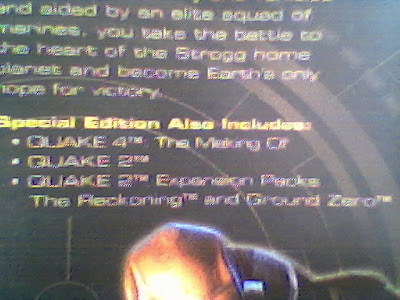
Included on the second DVD was Quake 2, and not only that, but also two Quake 2 Expansion Paks! I'd struck gold, finally! Now all I had to do was to talk zoombuggy around. Surely she'd allow me to spend $49.90 if I promised to pay part of the cost back at a later stage? It worked, she agreed, then asked this question: "What do I get in return?" Hm. Thought I'd better be fair and ask her what she wanted, so she said she'd go back to the Warehouse and look through their books section. In the end, zoombuggy gained three more Philippa Gregory books in return for me being able to purchase Quake 2. This would complete her series of Tudor stories. I think it'll be the last purchasing I'll be doing for a while, somehow.
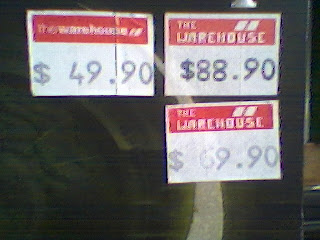 After I bought it, I decided to compare some prices. At EB Games where I'd gone before, I looked again on the shelf at the StarCraft collection they had tried to persuade me to buy ($54.95 for SC, expansion, and two guidebooks - actually a pretty good price), then checked on the shelf for Quake4 for the version I had just bought. Sure enough, I found it - at $89.83 (or something like that). Then I realised how much of a discount I'd got it for. I still wasn't sure if I was going to be able to run Quake 2 of course, but I looked at the machine requirements (90MHz Pentium, 24MB memory, 775 MB hard disk space) and thought let's give it a go, and took it home.
Of course I was going to need the Quake 2 binaries for Linux, not Windows, so I went ahead and installed those, and copied the data off the DVD into the right place on the hard disk. I had Quake 2! Started it up, it even ran for me, which surprised me considering that the specs had stated 16 MB of video memory. It turns out that Quake 2 has a perfectly usable software rendering mode, which runs perfectly acceptably on a K6-II @ 533MHz. Sure, I don't get the fancy graphical effects, but hey, I'm there to play the game, not admire the scenery. Another thing I don't get with it is the original Quake 2 audio tracks, as they supplied it on a DVD-ROM instead of a CD-ROM. Again, I can handle it, though the music apparently rocks.
My next purchase is to aim for completing the Command & Conquer series (there's a box called "Command And Conquer - The First Decade" that I'll have to buy), and work out which of the Tom Clancy games I can run on my machine, and fill out one or two more of his games. For some reason, I like them, though they don't play the same as Quake/DooM/Unreal Tournament. I think I'll dodge games like Flight Simulator*, Formula 1, Need For Speed, GTA**, and anything where I have to steer around a circuit. I suck at those games, big time.
(Updated on 23-5-2007) I also really like the Myst series from Raven Software. So far I have the first game "Myst" on a disc on its own, and the collection of the first five games that I also got for a cheap-ish price ($29.95), called "Myst, The Collection". I can't currently run games 4 or 5 yet, but the first three look pretty darn good.
To bring the story to an end (because this is getting to be a bit long...) I now have all the main cast of Quake games, though I can't play Quake 4 for quite a while, as that'll require a motherboard upgrade.
* EDIT: Several years later, I eventually bought Flight Simulator X on Steam, and have loved it. Time changes things sometimes.
** I also bought all but one of the GTA titles, at least to this date (Dec 2016).
So, be prepared to trawl the aisles at the Warehouse sometimes - you never know what you might find. Also, do check prices everywhere before you shell out your hard earned cash. Quite often, you'll get a pleasant surprise somewhere if you do. Incidentally, another option I was told about today (thanks, wishes), was to go online and go to trademe to look for a game there. I'm informed it's a good place to find games as long as you are prepared to observe the caveat emptor principle (buyer beware).
To summarise, these are the games I currently have in my collection - it's getting reasonably sized. Some of them are real old and I don't play them much, or they were given to me and I still haven't worked out how to play them yet.
- Age Of Empires, Rise Of Rome, Age Of Kings, Conquerors
- Beneath A Steel Sky, Lure Of the Temptress
- Command & Conquer
- Ultimate Doom, Doom II, Final Doom
- Duke Nukem 3D (including the first two Duke Nukem games)
- F1 2000
- Fifa 99
- Half Life (Game Of The Year), Team Fortress, Blue Shift, Opposing Force, Counter Strike
- Heroes Demo CD (contains demos of:
- Deadly Dozen
- Hitman
- Project IGI
- Rollercoaster Tycoon
- Tombraider Chronicles
- Totally Unreal
- Monsters Inc - Bowling for screams (Sample game)
- Moto Racer
- Myst Masterpiece Edition
- Myst: The Collection containing:
- Myst Masterpiece Edition (yes, a second copy)
- Riven
- Myst III: Exile
- Myst IV: Revelation
- Myst V: End Of Ages
- Quake and two expansion paks, Quake 2 and two expansion paks, Quake III Arena, Quake III Team Arena, and Quake 4
- Railroad Tycoon II (not strictly mine, more ... left here by the owner's mother)
- Spec Ops (Ranger Assault)
- Tactical Ops (Assault On Terror)
- Terracide
- The Need for Speed SE
- Thief (The Dark Project), Thief II (The Metal Age)
- Tilt!
- Tomb Raider I, Unfinished Business, Tomb Raider II, Tomb Raider III
- Tomb Raider - The Last Revelation, Tomb Raider Chronicles, Tomb Raider - Angel Of Darkness
- Tom Clancy's Rainbow Six, Rainbow Six: Rogue Spear
- Totally Unreal, containing Unreal (Game Of The Year), Unreal Na Pali, Unreal Tournament
- Worms 2, Worms World Party
And that's it. If I were able to stick these all on one hard drive, it'd take up quite a bit of space. And that's not even including any of the games that I've installed that aren't on a CD somewhere (i.e. games that came with Mandriva, or other Linux games (fillets-ng, xlogical, etc etc).
Hope you enjoyed this trip through nostalgia lane with me.
The latest offering from Sun.
Well. After all my bashing about Solaris not working on brick (the K6-II@533MHz, Apollo MVP4 chipset, 512MB) I actually tried it on fatty (a Celeron Coppermine@766MHz, 256MB) and got the surprise of my life. It WORKS on here! And it works like I expect! So now I'm writing this from Mozilla under CDE, on Solaris 6/06. It seems to behave rather nicely, though I've yet to do some more customising. One other thing I've found though, is the lack of hard drive space. I only installed on to a 3.2Gb drive, so I'm missing some things I wanted to experiment with, like the Sun Java Application Server Platform.
The real deal.
Now to the reason I installed Solaris to begin with: I wanted to see how programs behaved on a real UNIX™, and not on a clone like Linux, nor on a BSD variant. Not that I don't like Linux or FreeBSD, merely that I wanted to try the closest thing I was ever going to get to what has always considered to be real UNIX™. Anyhow, I'll leave this as just a real short note so far. No point in boring people with the few small struggles I've had learning how to "mount" a cdrom, or how to even get X to show a picture. Suffice it to say I've dealt with those. Only things left are sound, automounting CDs, and SunFreeware. and even that's not desperately important. I seem to remember there was a driver for my sound chipset out there somewhere, so I might hunt through my IRC logs to see what's around. Sun's Freeware (of course) is available freely, so all I have to do is scare up enough room... hmm, how about a new hard drive, people? Say, oooo... about 20GB?SunSet.
Cheers for now...time I went and played with CDE and all those wonderful things that make Solaris so unique. Now where did I put that DVD-ROM?
The Bad
It seems you’ve got somebody’s back up. In fact, you’ve got his back up so much he wrote a letter about it. It’s written up in a blog entry about it. For those of you still living under a rock, it seems that Microsoft signed yet another deal promising the following, among other items: As part of this agreement, Microsoft will provide a covenant not to assert its patent rights against customers who have purchased SUSE Linux Enterprise Server or other covered products from Novell, and Novell will provide an identical covenant to customers who have a licensed version of Windows or other covered products from Microsoft.
This of course made somebody at UWC rather peeved in the process. The text of the letter can be found at the first link above, and no doubt many other places too by now.
The Good?
Of course, there are other goodies in there, like: The two companies will create a joint research facility at which Microsoft and Novell technical experts will architect and test new software solutions and work with customers and the community to build and support these technologies. The agreement between Microsoft and Novell focuses on three technical areas that provide important value and choice to the market:
* Virtualization. Virtualization is one of the most important trends in the industry. Customers tell us that virtualization is one way they can consolidate and more easily manage rapidly growing server workloads and their large set of server applications. Microsoft and Novell will jointly develop the most compelling virtualization offering in the market for Linux and Windows.
* Web Services for managing physical and virtual servers. Web Services and service oriented architectures continue to be one of the defining ways software companies can deliver greater value to customers. Microsoft and Novell will undertake work to make it easier for customers to manage mixed Windows and SUSE Linux Enterprise environments and to make it easier for customers to federate Microsoft Active Directory with Novell eDirectory.
* Document Format Compatibility. Microsoft and Novell have been focusing on ways to improve interoperability between office productivity applications. The two companies will now work together on ways for OpenOffice and Microsoft Office users to best share documents and both will take steps to make translators available to improve interoperability between Open XML and OpenDocument Formats.
“As a result of this collaboration, customers will now be able to run virtualized Linux on Windows or virtualized Windows on Linux,” said Jeff Jaffe, executive vice president and chief technology officer at Novell. “Customers continually ask us how they can consolidate servers with multiple operating systems through virtualization. By working together, Novell and Microsoft enable customers to choose the operating system that best fits their application and business needs.”
... and The Ugly
I think I smell a rat here. A rather fishy smelling rat. From what I’ve read, it rather seems like Novell went to Microsoft and offered this deal, seemingly on a plate, although the actual mechanics (legal or otherwise) are beyond me at the moment. But one other tidbit I did get from the commentaries that I read was the fact that Novell would make a one-off payment to Microsoft, of course the amount is undisclosed. Now exactly why would they do this, given that Novell offer a free operating system (Suse) based upon the Linux kernel? And that it’s very unlikely that any of the Open Source code offered by Novell would infringe any patents claimed by Microsoft, valid or otherwise? Just who benefits here? I find it really really hard to believe this is merely a case of "You scratch our back, and we’ll scratch yours".
It's Virtually pointless
For anyone holding a valid Windows licence, they surely can run Windows how the hell they like. For anyone else, whether or not they choose to run Windows under a virtualization layer OR natively, they are still infringing upon the Microsoft End User License Agreement and no amount of finger—pointing to Novell is going to claim otherwise in a court of law, as the agreement only covers exercise of patents. Or do Novell want the ability to exercise some of those patents held by Microsoft so they can improve the virtualization experience?
Service ME now
Of course Web services are big. They’ve been saying that for the past ten years or so. Frankly when SOAP was first released, on April Fool’s Day, I thought the announcement really was the biggest April Fool’s joke yet. It turned out not to be so. And many of the other services available today (AJAX, etc etc) add to the experience. Why does Microsoft want a bigger slice of the pie? Haven’t they messed up IIS enough already? Granted, there is still no way of emulating an ActiveDirectory server without losing some of the functions that this piece of Microsoft technology provides, but not everyone needs all of that functionality. Do Novell want to be the company that is finally able to offer that, for their customers?
Documenting the Blob
Now, this makes more sense. Microsoft have been complaining for a very long time that there really is no need for the OpenDocument format to even exist, given that they consider their OpenXML format already does all a user could want and more, freely offered royalty—free to any user that is willing to use their format, for only the small cost of a blob of binary code in each XML file created. Whoops, did I say that? Sorry, Microsoft. Guess that’s not Open enough. Document the Blob, and we’ll talk further.
To wrap up
I’ll freely admit I don’t know most of the details of the agreement between Microsoft and Novell. Maybe it’s just as well I don’t. But I do know a lot of people in the Open Source community and in the Free Software community too are probably seething, shouting out comments like sellout, traitors, and .... yeah well, I won’t go there. Others have claimed that Microsoft eventually want to claim a "legal right" to run Linux, and that anyone else who has not purchased a license from Novell are then in infringement of any patents contained in Linux code that Microsoft think that they currently own. Does that sound like more of "Embrace, extend, eliminate alternatives"? Yeah, I thought I smelled a rat.
I had a drive that had some data on it, but it sounded like a miniature jet engine. I did have the sound file, but I've since lost it. Someone cheekily said it needs a new rubber band. As you can imagine, I grabbed all the data off it and stashed that onto another drive, which doesn't sound that bad. I've got a friend with a drive that sounds worse than that; it sounds so loud that I gave it the nickname "The Screamer", and it's only a bog-standard 3.4GB 3 1/2 inch IDE drive. For what its worth, here are some other bad drive sounds from Hitachi.
Part the first: An alternative to Squeak.
My forays into the world of the Smalltalk language are proving to be rather interesting. About seven years ago, a company called Cincom took over the rights to VisualWorks, another Smalltalk environment. They have commercial licences, of course. What made me sit up and take notice is that they also have a non-commercial licence for the exact same product. The License states you’re not allowed to use it in the running of a business, or to provide products that you would ordinarily charge for. In my case, as I do no production software anyhow, I’m hardly likely to choose to charge for what I do produce. So, I took up the non-commercial licence option, and downloaded VisualWorks and a goodly lot of goodies that go with it.
It’s certainly different than Squeak, in that it feels more integrated, and doesn’t have its own desktop, instead electing to create separate windows on the existing desktop, whether it be a Windows platform, MacOS, MacOS X, Solaris or Linux. There has obviously been a lot of work put into the product, as it seems to flow better than Squeak does, and given the length of time that VisualWorks has been around, I would expect that. There are even tutorials available for recent versions (currently released version is 7.4.1, hot off the presses back in May 2006) though some links on this list cannot be reached. I have noted that the wiki occasionally goes offline. I do of course have free books addressing VisualWorks (and Squeak too) but they tend to focus on the interface of VisualWorks 2.0, which is quite an old version in comparison. Still, the books will bear reading, because they will hopefully be future-proof enough for me to actually learn something about the current version I’m playing with. The books are also a good way of introducing the reader to the principles of Smalltalk in general, not just to the respective products.
Part the second: An agreement not to disclose.
So far I’ve found out that there is no decent web browser project that uses ST, and the one that has got the furthest has an NDA attached to it. As I haven’t signed it (and am unlikely to, at this rate), I can’t say what is actually IN the web browser code, and even if I had signed, I still couldn’t tell you (I’d have to kill you afterwards). From the look of it, the project’s not strictly a web browser, more one of those core components that everybody needs, or will soon if they only but knew it. If I were to take up the NDA, it would mean that I couldn’t discuss the code of the component with anyone whom I couldn’t verify as having also signed the same NDA. Ironically, this includes the author. Effectively, I’d have to request from my lawyer that his lawyer faxed over the document stating his agreement to his own NDA. Frankly, I can’t be bothered with all that unless it was mandatory. I’m beginning to see why rms feels the way he does.
Ordinarily, I would have no trouble in agreeing not to disclose. After all, I effectively agreed to several when I downloaded other programs onto my computer, such as QuickTime, IE, Macromedia Flash, and others of their ilk. I don’t have to distribute those, and I’m not allowed to even discover their source code, so I can readily agree to use but not disseminate. However, in the Smalltalk world, things are different. In the Smalltalk world, you can see all the source code for applications loaded into the image. For anyone wanting to protect any intellectual property from being ripped off and used in other products, they require others using that IP to sign agreements. I’m a bit wary of that, given the length of time they ask for this information to be kept hush-hush for. I seriously expect the product (as such) to be sold as a product on the market not unlike most modern software, however, I’m assured this isn’t the case. I will have to wait and see. If it becomes available under a more liberal agreement, I might then be able to use it; until then, I’ll have to be one of the have-nots.
Finalé in one part.
Given the state of play with Smalltalk web browsers, I think I won’t be holding my breath for anything fantastic. Scamper (the web browser commonly available in Squeak) is nearly as bare—bones as you can get a browser to be and still support images and table layout. TwoFlower, the browser available for VisualWorks, has had the plug pulled on it, doesn’t work on my current setup and is not being actively developed any more, since the author wants to concentrate on the new coding project. I haven’t seen any others except in projects like Inferno and Plan 9, which are themselves rather primitive and prone to crashing at inopportune moments, like when loading a page, for example. And the mere fact that Smalltalk uses a VM to interact with the user means that things will quite possibly be significantly slower than on a binary-code platform, even if Just-In-Time conversion to binary code from bytecode takes place. I did manage to get an IRC client that looks good though.
This wasn’t actually going to be a talk about web browsers, more my conclusions about Smalltalk environments in general; I guess that will have to wait until next time.
 Simply put, when I come across a game I (1) can run, and (2) can play, I like to get all the members of that family I can. As a result of waiting, I've gained quite a collection.
 They had bundled the first two Age Of Empires games with the first two accompanying expansion packs, and called it "Age Of Empires (Collectors Edition)". It would pad out my set of Age of Empires games that I wanted to get. I'd originally gained the first CD of Age Of Empires, collected from a cereal packet. I took a look at Age Of Empires III, just for a comparison, I guess that's another game I won't be running any time soon, as it requires more machine muscle than I have. So I'll stick with Age Of Kings. Anyhow, I bought that set, and in return zoombuggy ended up with two more books to fill out her Philippa Gregory collection. Fair trade, I thought.
 After I bought it, I decided to compare some prices. At EB Games where I'd gone before, I looked again on the shelf at the StarCraft collection they had tried to persuade me to buy ($54.95 for SC, expansion, and two guidebooks - actually a pretty good price), then checked on the shelf for Quake4 for the version I had just bought. Sure enough, I found it - at $89.83 (or something like that). Then I realised how much of a discount I'd got it for. I still wasn't sure if I was going to be able to run Quake 2 of course, but I looked at the machine requirements (90MHz Pentium, 24MB memory, 775 MB hard disk space) and thought let's give it a go, and took it home.