Starting small

Well, not totally random, but several gazillion combinations makes for a lot of choice. I’m referring of course to the
Rubik’s Cube... that ‘toy’ that has befuddled us from 1980 when Ernö Rubik put it on the market. Apparently when he first came up with the cube, he had to play with it for a whole
month before he was able to actually complete it for himself. Since then, of course records have tumbled with the lowest record for the 3x3x3 seemingly sitting at around 9.8 seconds or so (May 2007). That’s about the lowest quote I can find, at least for the moment. But wait, there’s more.
You broke me!

Some people get a little too frustrated with their cube, and attempt to solve it by less conventional means (i.e. cheating). Other reasons for disassembly include regreasing—a favourite of cubers everywhere is a product called Vaseline, otherwise known as petroleum jelly. For some speed cubers, another product is Silicone Grease. Adding a good grease makes the cube more fluid in operation (so you can turn the faces with greater ease) and is often the first item in setting up for speed-cubing (doing the cube really
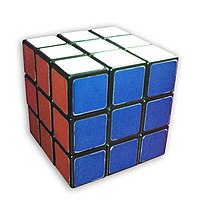
really fast). Cubes can’t be done disassembled of course, so put it back together—carefully now. The Rubik’s cube site has reassembly diagrams for the three most common cube formats, though not for the Professor’s Cube. Anyhow, when you’ve finished, it’s supposed to look like this.

A good cube will have a good smooth motion, not too tight or too loose. It shouldn’t be too easy to disassemble either, as the cube deteriorates the more often you have to disassemble it. These elements become more important the larger the cube, and the more you look after it, the longer it should last you before needing inevitable replacement. So far, I’ve found a marked difference between the real McCoy and other imitation products, so don’t go to the two dollar shop if you expect the cube to last longer than two minutes.
But wait, there’s more!
I first found out about the Rubik’s big brother “Rubik’s Revenge” in the late ’eighties, and have wanted a version since then. That’s a long time to want something without getting it. But hey, it happens. A few days ago, I found such a beast again, and decided to buy it, as the price was reasonable for New Zealand (only $30.00), and zoombuggy was okay with it.

This big brother has 7.4x10^45 combinations. Too large a number for me to even guess at pronouncing. I paid for it, brought it home, and found that the Rubik company had included a “Hints & Solutions” book with the cube in two parts. One part had the different instructions, each of them with a number that you used to look up the diagram in the
other booklet that had all the pictures in it. Needless to say, I found it strange. I decided to go to the related website and grab their downloadable booklets to take a look at them; went there, spent about an hour actually
finding the downloads, and snaffled copies of the other booklets too. This is where it gets interesting, because when I opened the downloaded booklet in my browser, it included the diagrams inline with the text as you’d normally expect. Only one ... quibble. The arrows pointing up, down, left, right, and around in 180 degrees, had been replaced with white numbers in black circles. Yay, not. Thankfully when I opened up the booklet for the original 3x3x3 Rubik’s Cube, it had arrows, and the diagrams were all in the right place. Strange, that.
It’s got how many cubes?
Anyhow, I aim to buy (when I can afford them) both the
Mini—Cube (2x2x2) (
which I’ve since purchased) and the Revenges’ even bigger brother, the
“Professor’s Cube” (shown at the back in the last picture below).
 That
cube has 2.8x10^74 combinations. I've even seen it advertised at
Amazon.com for only about US$26.00 or so, so it is at least able to be bought. That way, I’ll have the majority of the cube family, at least as put out by the Rubik company. I think I can safely skip the “cube on a keychain”, as it’s too flimsy to operate for long periods. Other varieties that I have already, include the Sudoku cube (a standard 3x3x3 cube that uses a different sudoku puzzle on each face), and “Square 1” (both pointed to by wikipedia). Grateful thanks go to the editors of the related wikipedia articles for their excellent pictures.
 Well, not totally random, but several gazillion combinations makes for a lot of choice. I’m referring of course to the Rubik’s Cube... that ‘toy’ that has befuddled us from 1980 when Ernö Rubik put it on the market. Apparently when he first came up with the cube, he had to play with it for a whole month before he was able to actually complete it for himself. Since then, of course records have tumbled with the lowest record for the 3x3x3 seemingly sitting at around 9.8 seconds or so (May 2007). That’s about the lowest quote I can find, at least for the moment. But wait, there’s more.
 Some people get a little too frustrated with their cube, and attempt to solve it by less conventional means (i.e. cheating). Other reasons for disassembly include regreasing—a favourite of cubers everywhere is a product called Vaseline, otherwise known as petroleum jelly. For some speed cubers, another product is Silicone Grease. Adding a good grease makes the cube more fluid in operation (so you can turn the faces with greater ease) and is often the first item in setting up for speed-cubing (doing the cube really really fast). Cubes can’t be done disassembled of course, so put it back together—carefully now. The Rubik’s cube site has reassembly diagrams for the three most common cube formats, though not for the Professor’s Cube. Anyhow, when you’ve finished, it’s supposed to look like this.
 A good cube will have a good smooth motion, not too tight or too loose. It shouldn’t be too easy to disassemble either, as the cube deteriorates the more often you have to disassemble it. These elements become more important the larger the cube, and the more you look after it, the longer it should last you before needing inevitable replacement. So far, I’ve found a marked difference between the real McCoy and other imitation products, so don’t go to the two dollar shop if you expect the cube to last longer than two minutes.
 This big brother has 7.4x10^45 combinations. Too large a number for me to even guess at pronouncing. I paid for it, brought it home, and found that the Rubik company had included a “Hints & Solutions” book with the cube in two parts. One part had the different instructions, each of them with a number that you used to look up the diagram in the other booklet that had all the pictures in it. Needless to say, I found it strange. I decided to go to the related website and grab their downloadable booklets to take a look at them; went there, spent about an hour actually finding the downloads, and snaffled copies of the other booklets too. This is where it gets interesting, because when I opened the downloaded booklet in my browser, it included the diagrams inline with the text as you’d normally expect. Only one ... quibble. The arrows pointing up, down, left, right, and around in 180 degrees, had been replaced with white numbers in black circles. Yay, not. Thankfully when I opened up the booklet for the original 3x3x3 Rubik’s Cube, it had arrows, and the diagrams were all in the right place. Strange, that.
 That cube has 2.8x10^74 combinations. I've even seen it advertised at Amazon.com for only about US$26.00 or so, so it is at least able to be bought. That way, I’ll have the majority of the cube family, at least as put out by the Rubik company. I think I can safely skip the “cube on a keychain”, as it’s too flimsy to operate for long periods. Other varieties that I have already, include the Sudoku cube (a standard 3x3x3 cube that uses a different sudoku puzzle on each face), and “Square 1” (both pointed to by wikipedia). Grateful thanks go to the editors of the related wikipedia articles for their excellent pictures.