07 August, 2007

Back to the Cube

It’s tiny, Dad!

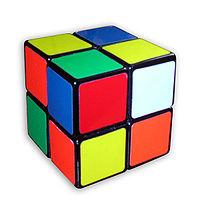
Nearly a couple of months back, I wrote here about the big Rubik’s Revenge cube that I bought, and the normal Rubik’s Cube. Today, I finally bought the tiny one, for the sum total of only $12.95— quite cheap, really.

It’s tiny! Only three million combinationsSo far, I’ve already scrambled it, put it back together (that surprised me!), AND scrambled it again. It might only have three million combinations (hah. only he says), but it's proving slightly tricky to put it back to rights. As with its really big brother, the 4x4x4 Rubik’s Revenge, it came with its own Solutions Booklet. Most of the pages described what a face was, what colours were on the cube, and what was in the pamphlet. Of the 16 pages, only one page showed actual moves that could be used on the cube to swap pieces around or to rotate them. Yes, this cube only has three sets of moves that get used to solve it.

Sell! Sell! Sell!

Oh yes, and the obligatory marketing for more of the Rubik’s products. For example, until today, I was unaware that there was also a Rubik’s Tangram (14 tangram pieces, which can of course be combined into many clever diagrams. I don't (yet) think I’ll be buying this one, much as I like playing with tangrams. As an aside, there is a Gtk program called gtans which shows a variety of shapes to fill in using the pieces. Quite challenging for some people. Anyhow, I’m sure you’ve all seen some of the other products produced as part of the company.

Missing link puzzleI came across one a couple of weeks after I bought the Revenge. It was a darn sight simpler, known as the “Missing Link.” You’d think it was relatively simple, but there’s a slight twist to it. Isn’t there always? The twist is—you can’t move the two middle sections independently, as they’re fixed in place, though you can still slide tiles through them. So really, it’s like a reorganised “15” puzzle. It took me quite a few minutes, but I solved it. Better results than I get with normal 15-puzzles.

Tick tock, time’s a’ running out

One other puzzle that I already have from the Rubik’s family I forgot to mention is the Clock puzzle. It’s got two sides, and nine clock faces on each side, linked by cogs and sliding elements that make it just a bit more tricky than you’d normally expect.Clock puzzle Of course, the aim is to set all the clocks to 12 ’clock. Laughs can be had by seeing if you can set each clock from 1 through to 9—I haven’t found out if this can be done yet. According to the wikipedia page for the puzzle, it’s a lot easier than the other puzzles, purely because the clock faces are linked.

Acknowledgements

And with that said, I must thank the authors of the related wikipedia.org articles I used for this blog, and also my thanks go to the owner of the Missing Link picture.

01 July, 2007

Another day of SUNshine

What, again?

Yes, only this time I had a little more room than before. The previous hard drive only had 3.2GB of space on it in total, so I had to leave some packages off the hard drive from the full install of Solaris 10. A few days ago, a friend of mine offered to send down two complete computer cases with motherboard and CPUs if I were to pay the postage. Funnily enough, zoombuggy agreed, as the idea was that she’d get her own computer back, with its own hard drive, and without any of my schlock on it. So we got them sent down, and I had a play.

They’re quiet, Jim

Yes, they’re quiet, and they’re also custom. The little ENS Compaqs quite often are. These machines are no exception, as they have Pentium-II motherboards, but they have Pentium-III CPU cards in them. Weird. One’s a 600 MHz CPU, the other is a 450 MHz CPU, so they're both slow, but not totally crawling. They also have (almost) tool-less cases. Again, weird, but I could get used to it. The main disadvantage is: there is only 128MB of memory in each machine, in two 64MB SDRAM sticks. So I’m now waiting for an awful lot of 128MB or 256MB SDRAM sticks that I can put into three computers. To make it worse, Kubuntu 7.04 doesn’t like having less than 256MB, and is running as slow as water on fire - personally I’ve found it runs okay with 384MB.

So now what happens?

Well, each of the computers had a 10GB drive. As one drive already had a complete Kubuntu 7.04 set up on it, I just moved on in, and got zoombuggy’s data shifted over. It seems funny, but I’d been wanting to upgrade her rather old Hoary Hedgehog installation (where do they come up with these names, anyhow?) for a while, and here I was, boom - up one distribution already, and without having to download a CD or DVD image. That was zoom and zoombuggy all jacked up, and I was up by one 4.3GB drive - that’ll probably have NetBSD put back on to it. The other machine (the 450 MHz) got the hard drive ripped out of it, which I used in fatty for the new Solaris install. Meanwhile (yes, I’ll get back to Solaris in a minute, Laura - just hold your horses) to make actual use of the machine and not have it lying around without a purpose, I put the Plan 9 drive into it. It works really REALLY well, in fact I’m frankly astounded. So, now my Plan 9 install has a machine all to itself. Once I corrected the IP I was using, and changed the hostname, it was good to go. I just wish it could get more use, but screens are at a premium here—I’ve only got two working screens, and I have to repair the third.

And now, the story about Solaris?

Yes Laura, on to Solaris. Well, as I said in the first paragraph, I had nowhere near enough room on the original drive, so I took the DVD writer out of brick and stuck it into fatty, so I could install Solaris on to the 10GB drive, and finally install everything off the DVDs that I had. I had to migrate a wee bit over from the original drive, such as the beta for Flash 9 player (yes, there IS one for Solaris x86), and the OSS commercial sound driver software - more on that in a bit. Now I’m the happy owner of a Solaris install that actually has all of its bits and isn’t missing anything. I also added Sun Studio 11 (it already had GCC) and NetBeans 5, but found the machine simply wouldn’t run the Java Studio Creator without bogging down. I guess that 256MB really isn’t enough, as I read the requirements afterward and found that 1GB would have been more like it. Of course, Solaris comes with Star Office 7, and a reasonably complete Motif 2.1 install, so I’ll at least have a bit of stuff to learn - and, it even has a complete install of Java SE5, so that I can start learning Java from that Bruce Eckel Java Book that I got from Amazon.com back in February or so. I’ve also added several packages from the Sun Freeware project, and several packages from the Solaris Companion disc. And Firefox, of course. So I’m happy, kind of.

But?

Yes, there’s a “but”. Currently the support in Solaris for sound is somewhat ... patchy. I have two ISA soundcards that don’t want to work under Solaris, even with the commercial OSS software that I downloaded. So for the moment at least, I ain’t got no lovin’ feeling ’bout that. If I happened to have an on-board AC97 sound chip, this would not be an issue, as:
  1. the sound card would be on the PCI bus, and not the ISA bus, and
  2. there's a AC97 sound driver in the Solaris kernel.
I know that works, as it worked somewhat under brick when I was running Solaris 3/05. So sound is the only issue I have, aside from memory (which could be worked on once I get some more 256MB memory sticks) and machine speed (probably requiring a motherboard upgrade).

And that's a wrap

Sure is. I'll have to do some more experimenting with Solaris, play with things a while. Frankly the version of Gnome I have here is ancient, to say the least. There are several aspects that have already been fixed in later versions of Gnome, such as the ability to change keyboard shortcuts. However, it does work, mostly. I don't have a whole lot of space left, but I have enough room in which to do some stuff, at least.
20 June, 2007

That's like, totally random

Starting small

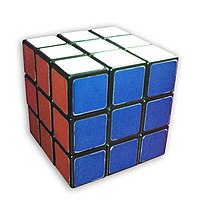
An old classicWell, not totally random, but several gazillion combinations makes for a lot of choice. I’m referring of course to the Rubik’s Cube... that ‘toy’ that has befuddled us from 1980 when Ernö Rubik put it on the market. Apparently when he first came up with the cube, he had to play with it for a whole month before he was able to actually complete it for himself. Since then, of course records have tumbled with the lowest record for the 3x3x3 seemingly sitting at around 9.8 seconds or so (May 2007). That’s about the lowest quote I can find, at least for the moment. But wait, there’s more.


You broke me!

Oops—the nephew dropped it. Honest!Some people get a little too frustrated with their cube, and attempt to solve it by less conventional means (i.e. cheating). Other reasons for disassembly include regreasing—a favourite of cubers everywhere is a product called Vaseline, otherwise known as petroleum jelly. For some speed cubers, another product is Silicone Grease. Adding a good grease makes the cube more fluid in operation (so you can turn the faces with greater ease) and is often the first item in setting up for speed-cubing (doing the cube really really fast). Cubes can’t be done disassembled of course, so put it back together—carefully now. The Rubik’s cube site has reassembly diagrams for the three most common cube formats, though not for the Professor’s Cube. Anyhow, when you’ve finished, it’s supposed to look like this. All done A good cube will have a good smooth motion, not too tight or too loose. It shouldn’t be too easy to disassemble either, as the cube deteriorates the more often you have to disassemble it. These elements become more important the larger the cube, and the more you look after it, the longer it should last you before needing inevitable replacement. So far, I’ve found a marked difference between the real McCoy and other imitation products, so don’t go to the two dollar shop if you expect the cube to last longer than two minutes.

But wait, there’s more!

I first found out about the Rubik’s big brother “Rubik’s Revenge” in the late ’eighties, and have wanted a version since then. That’s a long time to want something without getting it. But hey, it happens. A few days ago, I found such a beast again, and decided to buy it, as the price was reasonable for New Zealand (only $30.00), and zoombuggy was okay with it.
  56 cubes of colourThis big brother has 7.4x10^45 combinations. Too large a number for me to even guess at pronouncing. I paid for it, brought it home, and found that the Rubik company had included a “Hints & Solutions” book with the cube in two parts. One part had the different instructions, each of them with a number that you used to look up the diagram in the other booklet that had all the pictures in it. Needless to say, I found it strange. I decided to go to the related website and grab their downloadable booklets to take a look at them; went there, spent about an hour actually finding the downloads, and snaffled copies of the other booklets too. This is where it gets interesting, because when I opened the downloaded booklet in my browser, it included the diagrams inline with the text as you’d normally expect. Only one ... quibble. The arrows pointing up, down, left, right, and around in 180 degrees, had been replaced with white numbers in black circles. Yay, not. Thankfully when I opened up the booklet for the original 3x3x3 Rubik’s Cube, it had arrows, and the diagrams were all in the right place. Strange, that.

It’s got how many cubes?

Anyhow, I aim to buy (when I can afford them) both the Mini—Cube (2x2x2) (which I’ve since purchased) and the Revenges’ even bigger brother, the “Professor’s Cube” (shown at the back in the last picture below).The whole official family That cube has 2.8x10^74 combinations. I've even seen it advertised at Amazon.com for only about US$26.00 or so, so it is at least able to be bought. That way, I’ll have the majority of the cube family, at least as put out by the Rubik company. I think I can safely skip the “cube on a keychain”, as it’s too flimsy to operate for long periods. Other varieties that I have already, include the Sudoku cube (a standard 3x3x3 cube that uses a different sudoku puzzle on each face), and “Square 1” (both pointed to by wikipedia). Grateful thanks go to the editors of the related wikipedia articles for their excellent pictures.

06 June, 2007

Knuth, that's kuh-nooth.

\begin {article} And if you don't know who Donald Knuth is, just google for him and you'll see how important people think he is. His main passion of life is mathematics, but he also happens to be one of the more important names of computer science. His seminal (if I can use that term loosely) works include the five-part work The Art of Computer Programming, the TeXbook, Concrete Mathematics, and Selected Papers of Discrete Mathematics. There are of course a lot of other books that he has either produced, or at least had a rather large hand in producing. The Art of Computer Programming hasn't been completed yet, as only three volumes have been released so far, with two more volumes to be produced before he re-revises and releases his fourth edition of same. When viewing him in his video presentations (these are available from Stanford, and are linked to from his home page), I feel that he appears diffident, and rather unsure of himself. He quite often seems to be discovering the subject along with his students, though this turns out not to be the case, that he actually is viewing the subject from what commonly appears to be a completely different perspective—one not reached by most of his students. But the moments when his students and himself "get it" can seem almost like an epiphany. And for a mathematician, that's pretty heady stuff. I've also noticed that he also seems to jump around whatever subject he is covering, and seems to want to say a hundred things all at once. However, in contrast his writing appears confident, concise, and of course, accurate. You can hardly be otherwise when you're as famous a mathematician as he seems to be. Or is it Computer Scientist? I'm never quite sure. Any good scientist has hobbies, and he is no different—he owns his own small organ. Yes, it's a real organ. That's also covered in his home page, with its own special section describing it. I'm sure that's not his only hobby, as I've seen web pages devoted to diamond signs (imagine a square turned through 45 degrees, and something in the sign, and you have it), travel, and many other items I can't remember. So, go take a look. \end.

Linux for Suits - Beyond Blogging's Black Holes | Linux Journal (July 2007)

I'm rather sorry I have to point to just the abstract for this article from the well-established Linux Journal, but I can't point to the article directly: you can't view it unless you're already a Linux Journal subscriber. And even if you're a subscriber, it can take a bit of gymnastics to get to the actual article. I've already emailed them about that. Anyhow, do become a subscriber, it's a pretty good idea, in my opinion. Anyhow, Linux for Suits - Beyond Blogging's Black Holes | Linux Journal (July 2007) describes what happened to Doc Searls recently, due to what appears to be some narrow-minded or just plain stupid antics, and reactions to same. As a result, he states:
The old 'sphere ain't the same. And, the problem isn't just incivility and flamage. As old hands know, that's been around for the duration and will never go away. The problem is blogging itself. Somehow it's becoming more like TV and less like what made it great to begin with.
That's all I'm going to excerpt, so I can hopefully stay within "Fair Use". Thank goodness I'm only a small one-man blogging station with not a lot to say... hopefully nobody will abuse me in the comments merely for mentioning LJ or Doc Searls.